TRANSFORMING LIVES WITH CHALLENGERS
An organisation that helps hundreds of families across Surrey and the South East, we caught up with charity CEO Gen Dearman to talk about the transformative work of Challengers.
In your own words, can you explain who Challengers are?
Challengers are a charity who have been around since 1979, when two really cool people called Colin and Helen decided that disabled children didn’t get the same opportunities as their non-disabled peers. They wanted to change that and they took them swimming.
Almost 50 years later, sadly, disabled children still don’t get the same opportunities as their non-disabled peers – so we’re still trying to change that.
“We’re a charity that transforms the lives of disabled children, young people and their families through the power of play and it’s a very happy place to be.”
We support children throughout the year either through play and youth schemes, where they can come at weekends and school holidays – or with an alternative provision, which is for children who aren’t in education at the moment. We also have our Hub service, which opens up our centres when they’re not in use by our other services, providing a really lovely place for families to come and connect, to make friends and to play.
We offer a lot of holistic support as well, whether that’s helping with an application form or putting on some healthy parent carer workshops. We want to support the whole family and will hopefully be doing it for another 50 years.
What does a day in the life of Challengers look like?
Oh gosh, fun and loud. Before the children walk in the door, our play and youth workers are here, making sure activities are set up and the centres are ready to open but also looking at the children we have coming through our doors and familiarising ourselves with them. We have a non-exclusion policy, which is quite unique, believe it or not, for a disability charity. Which means we welcome all children no matter how complex their needs are.
So at the start of the day the staff will read the notes about the child. Whether they have any allergies, what medicines they’re on, whether they need any extra help with support or mobility. And also, what they like doing and what they struggle with. We plan that ahead of the day and then the doors open, and the parents pop their kids in the door with big smiles on their faces – that’s the children as well as the parents – and we have a day of fun.
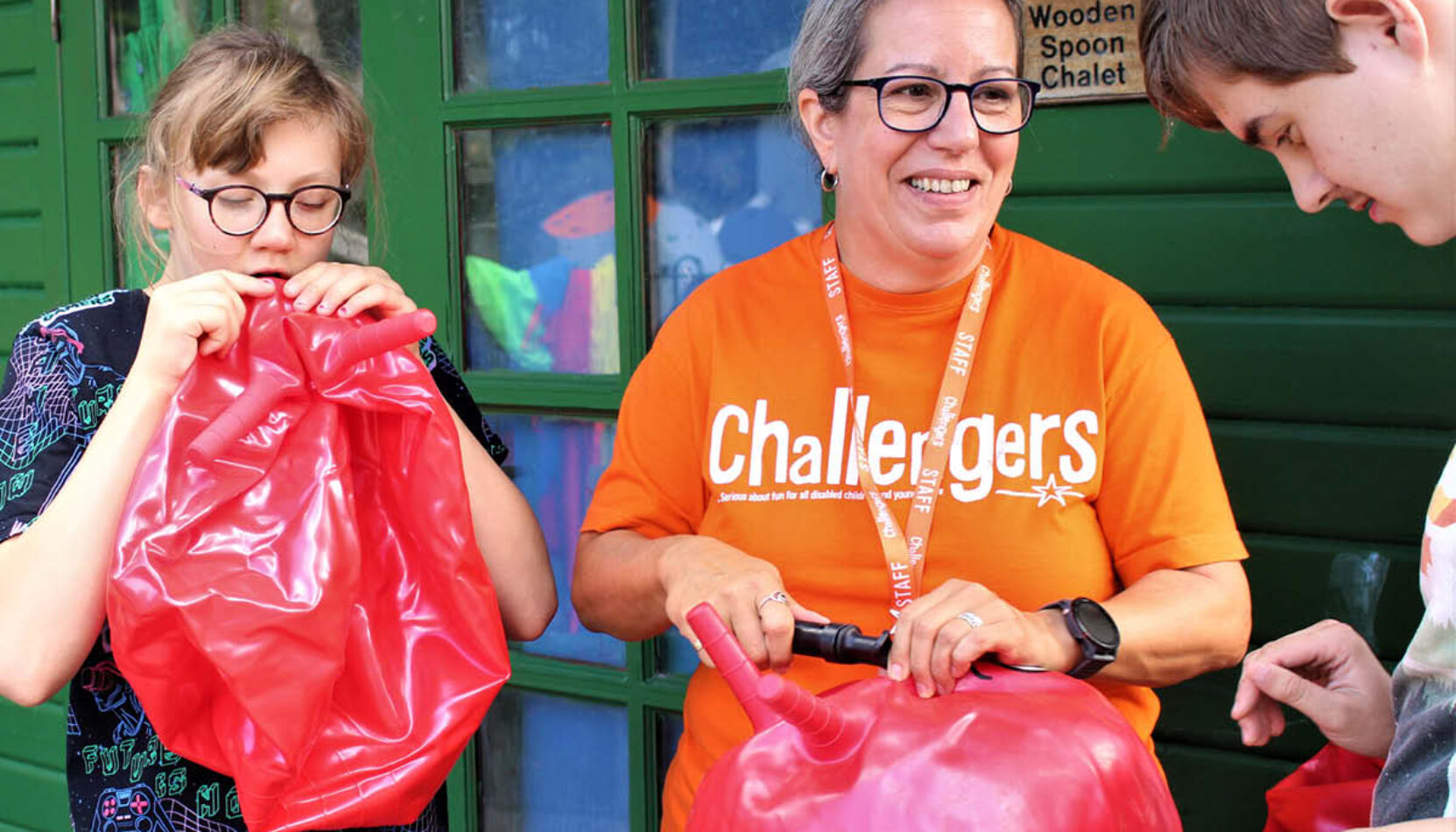
Everything we do is play-based, and we’re led by the child. So we might do drumming, but if that child doesn’t want to do drumming and wants to go out in the rain and bounce on the trampoline, well then, it’s a good job our skin is waterproof, because we’ll be bouncing around on the trampoline. And then the children go home and we do a debrief. So that’s a day in the life on the shop floor of Challengers.
What is the greatest day-to-day challenge for Challengers as a charity?
You’ve got funding or lack of funding and rising costs – National Insurance put £40k overnight on our wage bill, so actually meeting needs becomes the greatest challenge. It’s so hard knowing that we want to do more for the families that we know and see a waiting list of families increase. What else can we do differently to reach those families?
Our home is Surrey, but we operate across the South East and we helped 950 families last year. The last time I looked at the waiting list, we had over 600 families on there. In Surrey alone it’s 300 families.
What are your day-to-day responsibilities at Challengers?
I think my most important day-to-day responsibility is being Challenger’s biggest cheerleader. Whether it’s working with the staff team or externally and being an advocate, i think there’s a day that goes past that I’m not singing the praises of the charity in one way, shape or form; that is a sad day. What that also means is making sure we deliver our strategy, building partnerships, looking after our trustees, and preparing for the board. Compliance and risk, which are no one’s favourite but very, very essential.
Being seen on the playfloor, i think it’s really important that i do understand what the playstaff go through and know the children that come to us. And other times I’ll be helping Becky (events manager) pack for an event – there is no one size fits all to being a charity CEO.
You’ve been CEO of Challengers for over four years now – what changes have you overseen in your time to date?
There’s been quite a bit of change in four years. It’s a really tough environment for all charities out there at the moment. We’re seeing rising costs, we’re seeing unprecedented demand for services, and we’re seeing fundraising challenges – it’s like this triumvirate of issues.
What we’ve had to do to make sure that we are here in another 50 years is look at all our services and saying, ‘for every £1 that comes in, are we spending most of that on our children?’ because that’s really important. And then, what are they costing us? If we’re struggling to fund them and they’re using our reserves, is there a way we can change that? And sadly for our preschools, as much as we tried, we couldn’t. So we have shut two of our preschools, which was a really hard decision to take. You don’t come into a charity wanting to shut services, but it was one that we had to do to protect the charity for the future.,
And then the flip side is that we’ve seen a real increase in children who are either excluded from a special school because of their behaviour or there’s not a school in their area that meets their needs. Our alternative provision (555) has expanded. When I started, we had one service and we have just launched our thor service, helping children as young as five come to us up to three days a week. We’re not a school, but what we do is that during term time, we can help them with routine; we can help with behaviours; we can give them somewhere to go, and we can give the parents a break. And it just gives them something while the local authority is trying to find a school place.
We get to learn about the children and their behaviour and sometimes that means we can help the local authority get that child back into school.
New in the last few years is The Hub, which supports families holistically. We asked parents what more can we do to support you?’
And they said, ‘help us find our tribe – it’s really isolating being a parent of a disabled child.’ They wanted us to open our centres when we’re not running services so that they have somewhere that they can come and feel safe and their children can play freely. They also wanted help navigating the system – because whether you’re pre-diagnosis and you know this is the start of your journey or you’ve been in it for 13 years, it’s really tough!
The Hub, with funding from the National Lottery, was launched four years ago to do just that. It’s increased our reach in terms of families that we’re able to support by several hundred, which is really, really good.
In February, the government announced significant reforms to SEND provision in the UK – how do you envisage this affecting the charity?
I think the greatest impact of this is going to be on our parents. When the white paper came out, there were so many unknowns in it. There were things that they put down that just generated more questions around the complexity of need – ‘well what do you mean by ‘complex’? – because ‘complex’ can mean so many different things to so many people.
I love the ambition of true inclusion. Our vision is of a world where all children can play together freely. True inclusion costs more money, and I just want a bit of reassurance that the white paper is there for that, for true inclusion, and not for cost-cutting, because you can read it both ways.
I’m concerned about what removing EHCPs will do to some families. Every child has the right to get the support they need to be able to thrive. And every family has the right to contest that support if they don’t think it’s the right support for their child. So the white paper makes me feel quite nervous about the uncertainty our families are going to face.
How can the community get involved and help Challengers?
There are so many ways. You can fundraise for us, you can volunteer for us, you can run an event, you can follow us on our socials, and you can share our socials. We are so reliant on people’s goodwill to do something bonkers to help support our fundraising. Whether you want to run a marathon or you want to bake a cake – it all matters hugely; there’s no limit to the ways people can get involved.
For more information and to donate, visit disability-challengers.org